

Sustainability · 2025
In this section55 topics
- Sustainability Policy3 items
- Sustainability Goals & UN SDGs3 items
- Policy Review3 items
- Business Value Chain1 item
- Stakeholder Analysis1 item
- Environmental Sustainability — Overview1 item
- Environmental Policy & Guidelines4 items
- Environmental Policy Review3 items
- Energy — Plan & Guidelines3 items
- Energy — Electricity Consumption1 item
- Energy — Fuel Consumption1 item
- Energy — Targets2 items
- Energy — Performance & Outcomes2 items
- Water — Plan & Guidelines4 items
- Water — Withdrawal, Discharge & Consumption1 item
- Water — Targets2 items
- Water — Performance & Outcomes2 items
- Waste Management — Overview1 item
- Waste — Plan & Guidelines2 items
- Waste — Generation, Disposal & Recycling1 item
- Waste — Targets2 items
- Waste — Performance & Outcomes2 items
- Greenhouse Gas — Overview1 item
- GHG — Plan & Guidelines3 items
- GHG — Emissions1 item
- GHG — Emissions Verification2 items
- GHG — Principles & Standards2 items
- GHG — Targets2 items
- GHG Targets — Net Zero1 item
- GHG Targets — Carbon Neutrality1 item
- GHG — Performance & Outcomes2 items
- Environmental Legal Incidents1 item
- Other Environmental Management1 item
- Social Policy & Guidelines4 items
- Social Policy Review3 items
- Social — Principles & Standards Practised1 item
- Human Rights Due Diligence3 items
- Employees — Plan & Guidelines4 items
- Employees — Workforce2 items
- Employees — Remuneration & Provident Fund1 item
- Employees — Training & Development1 item
- Employees — Occupational Health & Safety1 item
- Employees — Labour Relations1 item
- Employees — Employee Representation3 items
- Employees — Targets1 item
- Employees — Performance & Outcomes2 items
- Customers — Plan & Guidelines4 items
- Customers — Satisfaction Results2 items
- Customers — Targets2 items
- Customers — Performance & Outcomes2 items
- Community & Social — Plan & Guidelines4 items
- Community & Social — Targets2 items
- Community & Social — Performance & Outcomes2 items
- Other Social Management1 item
- Law Violation Incidents1 item
Sustainability Policy
Has a Sustainability Policy
Yes
Policy Description
Energy Absolute Public Company Limited and affiliated companies (EA group) aim to be a leader in the alternative energy business, by adopting modern and environmentally friendly technologies to deliver optimal benefit to consumers, shareholders, business partners and employees in a fair and responsible manner.
Accordingly, EA group has established a Sustainability Development Policy covering Environmental, Social, and Economic & Governanace dimensions. This policy aligns with EA Sustainability Framework and implements as a guiding principle for business operation under EA group, ensuring business development without compromising positive environmental and social impacts, while ensuring compliance with relevant international standards. All executive management and employees of EA group are expected to implement this policy consistently across the organization.
Sustainability policy of EA group is established as follows:
Economic & Governance
Corporate Governance : Establish and implement a corporate governance plan and practices in accordance with the Good Corporate Governance Policy approved by the Board of Directors, with transparent and verifiable disclosure of information to stakeholders.
Business Ethics and Anti-Corruption : Uphold the Business Code of Conduct and a zero-tolerance policy against all forms of corruption, while promoting compliance among suppliers and business partners throughout the value chain.
Risk Management and Crisis Preparedness : Integrate ESG into EA’s Enterprise Risk Management (ERM) framework in alignment with the Committee of Sponsoring Organizations of the Treadway Commission (COSO) framework, covering both emerging risks and climate change–related risks. Key risk issues are reported, as appropriate, to senior management, the Risk Management Committee, and the Board of Directors. In addition, the Company promotes both internal and external training programs to enhance employees’ awareness and understanding of relevant risks.
Supply Chain Management : Strengthen relationships with suppliers through annual sustainability risk assessments, while encouraging suppliers to conduct their businesses responsibly with respect to social and environmental considerations and in compliance with applicable laws and regulations.
Innovation for Sustainability : Drive growth through business innovation that creates competitive advantages while delivering positive social value and encourage innovation development both within the EA Group and among relevant stakeholders.
Environmental
Environmental Management Integration : Establish quality, environmental, occupational health, and safety policy consistently across the Group and integrate them into operational processes throughout the entire value chain.
Legal Compliance : Strictly comply with environmental laws and regulations, with the aim of becoming an organization with zero environmental complaints.
International Standards : Develop action plans to reduce environmental impacts and enhance environmental management practices in line with international standards, such as ISO 14001.
Social
Human Rights and Labor Practices : Respect human rights and ensure fair and equitable treatment of all employees.
Human Capital Development : Promote learning and skills development (upskilling and reskilling) to support future business growth.
Creating Shared Value (CSV) : Foster community sustainability through the EA 3S Model, enhancing quality of life and creating a balanced approach between business growth and sustainable social development.
Policy Document Link
https://sustainability.energyabsolute.co.th/en/document/viewer/16/sustainability-policy
Sustainability Goals & UN SDGs
Has Sustainability Goals
Yes
Goals Description
The vision of Energy Absolute Public Company Limited is to be a leader in alternative energy business, by adopting modern and environmentally friendly technologies to deliver optimal benefit to consumers, shareholders, business partners and employees in a fair and responsible manner.
Accordingly, the EA Group has identified Sustainability Management Goals to drive sustainable development across the organization. Relevant local and global sustainability frameworks and directions are considered in defining the Sustainability Management Goals of EA Group. In addition, both existing and emerging risks and opportunities are taken into account.
Procedure in Assessment of Materiality for Sustainability Development
EA Group has identified key current and future issues relevant to its business operations and engaged with all stakeholder groups to gather their comments. This process ensures that EA Group’s operations can be driven continuously and effectively support strategic decision-making. The insights obtained are incorporated into the sustainability materiality assessment, which consists of the following four steps.
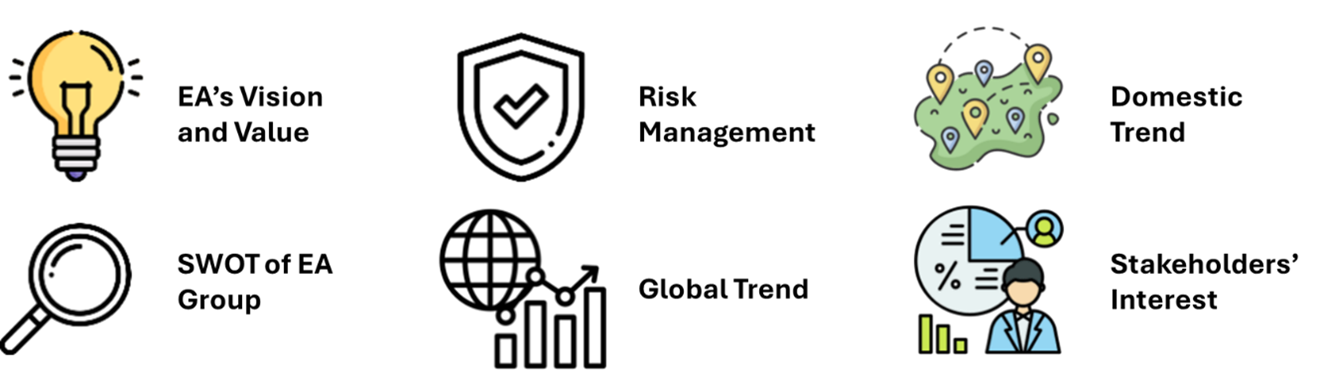
Consideration : Consider material issues related to internal and external factors, as well as both impact materiality and financial materiality - corporate strategy, stakeholder interests, risk issues, economic trends, industry transformation, technological and change in innovation, and climate change.
Review and Identify : Review and identify the company's key stakeholder groups. Explore the opinions and expectations of these key stakeholder groups on how issues relate to environmental and social impacts, as well as their potential to influence the Group’s financial outcomes, risks, and opportunities.
Materiality : The issues gathered from stakeholders are compared against the corporate strategy, business direction, risk factors, etc, then prioritizing material issues. A survey is then sent to the Board of Directors and senior executives for prioritization.
Verification : The issues are verified by the executive committee and approved by the Board of Directors to confirm their alignment with the organization's goals and strategies, and to be used for developing short-term, medium-term, and long-term sustainability strategies, targets, and action plans.
Consideration Factors in Assessment of Materiality
Framework of Sustainability Development
Environmental, social and economic aspects constitute the core dimensions of EA sustainability framework. Across the framework, corporate governance, compliance, sustainable risk management, and ethics and transparency are integrated into all core dimensions to comprehensively strengthen sustainable business operations across EA Group. The Sustainability Development Framework ensures that sustainability is embedded in the long-term strategic direction of the organization and incorporated into decision-making at all levels.
Environment
Sustainable Resource Stewardship
Focus on responsible sourcing and conservation of energy, water, and materials
Manage natural resources responsibly to prevent depletion and environmental degradation
Support long-term ecosystem resilience across operations and the value chain
Efficient Use of Resources
Improve operational efficiency to optimize energy, water, and other resources consumption
Conduct a process improvement to reduce waste generation and emission
Circular Economy
Integrate circular principles such as reduce, reuse, recycle, and recovery
Responsible for end-of-life products
Biodiversity
Conduct a process improvement and apply new technologies to prevent and minimize negative impacts on ecosystems and biodiversity
Analyze and support biodiversity conservation initiatives where operations may have impacts
Climate Mitigation and Adaptation
Reduce greenhouse gas emissions (GHG) through energy efficiency and other GHG reduction projects
Identify and manage climate-related risks and opportunities
Enhance resilience to physical and transition climate impacts
Social
Workforce Development and Well-being
Promote employee learning, skills development, and career advancement
Foster a safe, inclusive, and supportive working environment through E@ DNA culture
Support employee well-being, engagement, and work–life balance
Occupational Health and Safety
Maintain safe working conditions and emergency preparedness
Improve safety performance through training and monitoring continuously
Prevent work-related injuries and illnesses through proactive safety devices and management
Human Rights
Prevent forced labor, child labor, and discrimination
Assess human rights related issues continuously and engage all stakeholders
Establish mechanisms to address grievances and remedy adverse impacts
Social Responsibility Oversight
Monitor compliance with laws, standards, and internal policies
Support communities around EA through CSV programs, and employment
Stakeholder Engagement
Engage stakeholders transparently to understand expectations and concerns
Conduct a stakeholder engagement through various methods, i.e. survey, questionnaire, community meeting, customer feedback.
Incorporate stakeholder feedback into decision-making and strategy
Economic
Information Security
Protect information assets from unauthorized access and cyber threats
Maintain data confidentiality, integrity, and availability
Strengthen digital resilience through controls, awareness, and monitoring
Sustainable Supply Chain Management
Promote responsible supply chain sourcing
Assess ESG risks through the supply chain
Communicate and conduct an EA supplier’s ESG program training to supplier
Strengthening Local Economy
Support local businesses, employment, and community development
Encourage local procurement and knowledge sharing
Embracing Innovation and Digitalization
Leverage innovation and digital technologies to enhance production efficiency
Support data-driven decision-making
Sustainable Product Development
Integrate sustainability considerations into product and service design
Minimize environmental and social impacts across the product life cycle
Green Finance and Investment
Align financial decisions with sustainability and climate objectives
Support investments in low-carbon and environmentally responsible projects
UN Sustainable Development Goals
| SDG Goal |
|---|
| Goal 3 Good Health and Well-being |
| Goal 3 Good Health and Well-being |
| Goal 3 Good Health and Well-being |
| Goal 3 Good Health and Well-being |
| Goal 4 Quality Education |
| Goal 5 Gender Equality |
| Goal 5 Gender Equality |
| Goal 5 Gender Equality |
| Goal 5 Gender Equality |
| Goal 6 Clean Water and Sanitation |
| Goal 6 Clean Water and Sanitation |
| Goal 6 Clean Water and Sanitation |
| Goal 6 Clean Water and Sanitation |
| Goal 7 Affordable and Clean Energy |
| Goal 8 Decent Work and Economic Growth |
| Goal 12 Responsible Consumption and Production |
| Goal 13 Climate Action |
| Goal 13 Climate Action |
| Goal 13 Climate Action |
| Goal 13 Climate Action |
| Goal 15 Life on Land |
| Goal 15 Life on Land |
| Goal 15 Life on Land |
| Goal 15 Life on Land |
| Goal 16 Peace, Justice and Strong Institutions |
Policy Review
Policy Reviewed This Year
Yes
Policy Changed This Year
Yes
Review Details
EA group has revised and updated the sustainability management policy and goals in 3 areas as follows:
Sustainability Framework
Objective : The Sustainability Framework is a cornerstone of EA group’s long-term strategic direction. The ultimate goals are to create positive impacts while supporting Thailand’s transition to a low-carbon and sustainable future.
Guidelines : The EA Sustainability Framework integrates environment, social, and governance (ESG) considerations into core business operations, ensuring that sustainability is not only a guiding principle but a driver of innovation, resilience and stakeholder value. Sustainability will be embedded into every level of business decision-making.
Sustainability Strategy
Objective : The Sustainability Strategy, known as the “Triple-E Strategy”, supports the effective implementation of Sustainability Framework and proactively address the escalating challenges of climate change, energy transition, and evolving societal expectations. It is a foundational blueprint for guiding long-term, resilient business growth while simultaneously delivering positive and measurable impacts across environmental, social, and economic dimensions.
Guidelines : The Sustainability Strategy is a holistic transformation agenda including the emission revolution, emission innovation, and emission economy. It spans renewable energy development, clean mobility solutions, advanced battery innovation, circular economy integration, stakeholder engagement, and inclusive local community development.
Sustainability Policy
Objective : The Sustainability Policy encompasses Environmental, Social and Governance (ESG) dimensions
to drive the organization towards long-term sustainability, in alignment with the United Nations Sustainable
Development Goals (UN SDGs) and international sustainability assessment standards.
Guidelines : The Sustainability Policy defines the responsibilities of all relevant parties. It emphasizes the policy across governance, anti-corruption, cyber security, human rights, resource development, low-carbon innovation, supplier code of conduct, and responsible procurement, stakeholder engagement, social and community development, climate risk and opportunity, energy and resource efficiency, environmental management, and biodiversity.
Business Value Chain
Value Chain Description
EA Group considers the importance of taking a comprehensive view of the business value chain as a key factor in effective risk management and the creation of sustainable value. Understanding the economic, social and environmental impacts at every stage of the value chain enables EA Group to define responsible operating approaches from upstream to downstream activities. In addition, value chain consideration supports strategic decision-making, enhances operational efficiency, and ensures an appropriate response to stakeholder expectations.
Biodiesel Business
1. Feedstock Procurement :
Source key raw materials such as Used Cooking Oil (UCO) and Crude Palm Oil (CPO) from responsible and legally compliant suppliers. Ensure adherence to stringent environmental standards to prevent deforestation and promote sustainable sourcing practices.
2. Production Process :
Enhance environmentally friendly production efficiency by optimizing the use of resources, energy, and water. Implement effective management of pollution and greenhouse gas emissions in accordance with international standards, while maintaining strict occupational health and safety measures for employees.
3. Distribution and Utilization :
Distribute high-quality biodiesel products that meet established standards to support the adoption of renewable energy and the reduction of greenhouse gas emissions. Continuously communicate safety and environmental information to business partners.
Renewable Energy Power Generation Business
Project Development :
Select project sites with careful consideration of environmental impacts, ensuring that biodiversity assessments are conducted for the area. Social aspects and the well-being of surrounding communities are also taken into account throughout the project development process.Electricity Generation from Solar and Wind Energy :
The Group places strong emphasis on managing potential environmental impacts, safety and biodiversity concerns arising from project operations. Open communication channels are maintained with local communities to gather feedback. In the event of complaints, prompt actions are taken to address issues effectively, thereby minimizing impacts on business operations and corporate reputation, while fostering positive relationships with surrounding communities.Electricity Supply :
Deliver clean energy into the power grid to support the country’s transition toward sustainable and renewable energy.
Battery and Commercial Electric Vehicle Business
Raw Material and Component Procurement :
The Group places strong emphasis on sourcing key raw materials and components for battery production and electric vehicle assembly. This includes upholding human rights responsibilities throughout the supply chain, managing risks related to resource scarcity, and ensuring full compliance with applicable laws and regulations.Electric Vehicle Manufacturing and Assembly:
Enhance efficiency in vehicle assembly and battery production processes, with a focus on the use of clean energy and efficient resource utilization. Strict controls are implemented for hazardous waste management, alongside maintaining the highest standards of safety.Product Usage and End-of-Life Management :
The Group supports the safe and efficient use of commercial electric vehicles through comprehensive after-sales services. Dedicated research and development in battery technology is conducted with a strong focus on safety and end-of-life management, in alignment with circular economy principles.
Stakeholder Analysis
Stakeholder Analysis
| Stakeholder Type | Stakeholders | Stakeholder Expectations | Response to Expectations | Communication Activities |
|---|---|---|---|---|
| Internal stakeholders | 2921 · Description: Employees | • Fair compensation, welfare, and benefits
• Career opportunities and Happiness in the workplace
• Human rights and labor practices
• Capability development
• Safety in the workplace | • Standard safety management
• Standard environmental management
• Provident fund
• Strict compliance with human rights and employment policies
• Career path and advancement
• Development staffs by using Knowledge Management | 2945 · Description: Complaint Reception · 2946 · Description: Employee Engagement Survey · 2949 · Other name: Mailbox · Description: Others · 2949 · Other name: HR internal communications · Description: Others · 2949 · Other name: Town Hall Meeting · Description: Others |
| External stakeholders | 2899 · Description: Suppliers · 2923 · Description: Customers | • Confidence in tools, equipment, production processes, and service delivery
• Safe working environment
• Business transparency
• Human rights and labor practices
• Social and environmental impacts arising from the Company’s operations
• Personal data breaches
• Data collection and usage
• Product and service quality in meeting customer and partner expectations
| • Clear and standardized procurement policy
• Anti-corruption policy and promotion of implementation
• Good corporate governance with transparency, fairness, and accountability
• Code of conduct for the protection of confidential information
• Regular improvement and maintenance of equipment to ensure efficiency
• Dedicated research team for continuous development of products and services | 2943 · Description: External Meeting · 2945 · Description: Complaint Reception · 2947 · Description: Satisfaction Survey · 2949 · Other name: Meeting on occasions · Description: Others · 2949 · Other name: Responding to Disclosure Requests · Description: Others · 2949 · Other name: Contract and Written Agreement · Description: Others |
| Internal stakeholders | 2904 · Description: Investors or investment institutions · 2913 · Description: Shareholders | • Qualifications of Board of Directors and the management
• Opportunity and Risk management
• Operating results and business growth
• Business transparency
• Value creation for economy, society, and environment | • Anti-corruption policy and promotion of implementation
• Good corporate governance with transparency, fairness, and examinability
• Appropriate dividend payment
• Transparent information disclosure
• Preparation of appropriate business plans and risk management | 2938 · Description: Visit · 2941 · Description: Online Communication · 2944 · Description: Annual General Meeting (AGM) · 2949 · Other name: Information disclosure to investors and shareholders · Description: Others · 2949 · Other name: Information presentation at Opportunity Day and Analyst Meetings, as well as dissemination of information on the Company’s website · Description: Others |
| External stakeholders | 2902 · Description: Community · 2928 · Description: Society | • Community engagement and relations
• Human rights and labor practices
• Environmental impacts
• Quality of life development and income generation for communities
• Product and service quality in meeting community and societal needs | • Human rights policy
• Anti-corruption policy
• Good corporate governance with transparency and accountability
• Support for public interest activities
• Environmental policy | 2945 · Description: Complaint Reception · 2947 · Description: Satisfaction Survey · 2949 · Other name: Communication through employees residing in local communities · Description: Others · 2949 · Other name: Meetings on appropriate occasions · Description: Others · 2949 · Other name: Public information on EA’s Website · Description: Others · 2949 · Other name: Community engagement activities · Description: Others |
| External stakeholders | 2936 · Other name: Environment / Civil Society · Description: Others | • Quality of life development and income generation for communities
• Transparency and information disclosure
• Social and environmental impacts
• Value creation for the economy, society, and the environment | • Human rights policy
• Anti-corruption policy
• Good corporate governance with transparency and accountability
• Support for public interest activities
• Environmental policy | 2945 · Description: Complaint Reception · 2949 · Other name: Public information on EA’s Website · Description: Others · 2949 · Other name: Clarification of the facts to the public · Description: Others · 2949 · Other name: Publication of Annual Report and Sustainability Report · Description: Others |
| Internal stakeholders | 2932 · Description: Joint venture partners | • Business transparency
• Human rights and labor practices
• Social and environmental impacts arising from the Company’s operations
• Enterprise opportunity and risk management
| • Anti-corruption policy and promotion of implementation
• Good corporate governance with transparency, fairness, and accountability
• Transparent information disclosure
• Appropriate business planning and risk management | 2949 · Other name: Board and management meeting for subsidiaries and · Description: Others · 2949 · Other name: Public information on EA’s Website · Description: Others · 2949 · Other name: Publication of Annual Report and Sustainability Report · Description: Others |
| External stakeholders | 2894 · Description: Creditor | • Business transparency
• Human rights and labor practices
• Enterprise opportunity and risk management | • Anti-corruption policy and promotion of implementation
• Good corporate governance with transparency, fairness, and accountability
• Transparent information disclosure
• Appropriate business planning and risk management | 2949 · Other name: Meeting between Management and Creditors · Description: Others · 2949 · Other name: Public information on EA’s Website · Description: Others · 2949 · Other name: Publication of Annual Report and Sustainability Report · Description: Others · 2949 · Other name: Contract and Written Agreement · Description: Others |
| External stakeholders | 2936 · Other name: Government Sector · Description: Others | • Business transparency
• Human rights and labor practices
• Enterprise opportunity and risk management
• Social and environmental impacts arising from the Company’s operations | • Anti-corruption policy
• Good corporate governance with transparency and accountability
• Transparent information disclosure
• Appropriate business planning and risk management
• Environmental policy | 2949 · Other name: Meeting between the Company and related Sector · Description: Others · 2949 · Other name: Partnership and supports of Government’s Projects · Description: Others · 2949 · Other name: Public information on EA’s Website · Description: Others · 2949 · Other name: Publication of Annual Report and Sustainability Report · Description: Others |
Environmental Sustainability — Overview
Operating Results — Introduction
Energy management is a significant issue for EA Group, as energy is the core business (energy generation and distribution) and the important resource for our operations. Efficient energy management, renewable energy adoption and environmental impact reduction from energy use serve as key mechanisms in driving EA Group toward sustainable business operations and supporting the achievement of greenhouse gas reduction targets at both EA Group and national levels.
EA Group implements comprehensive energy management practices through various energy conservation initiatives, including continuous improvement and the adoption of high-efficiency technologies to minimize energy use and negative environmental impacts. EA Group complies with applicable energy-related laws, standards, and regulations, while regularly monitoring, reviewing, and enhancing energy conservation measures to ensure operational continuity and long-term sustainability.
Environmental Policy & Guidelines
Has an Environmental Policy
Yes
Policy Description
Energy Absolute Public Company Limited and its subsidiary companies (EA Group) are committed to advancing high standards of management in business operations along with sustainable environmental management. EA Group highly emphasizes occupational safety, health, and environmental protection, while upholding social responsibility. In addition, EA Group prioritizes effective resource management across the entire value chain — from business due diligence in mergers and acquisitions, raw material sourcing, production, and transportation, to post-consumption waste management — to prevent and mitigate potential environmental and community impacts. This commitment is a core responsibility of management level and all employees, as well as business partners, suppliers, contractors and relevant stakeholders.
Guidelines for Implementation
To be a leader in alternative energy business, electric vehicle business and battery for electric vehicle by using modern technology and environmentally friendly for the best benefit of shareholders.
To comply with all applicable quality health safety and environmental laws and regulations as well as other business operation and stakeholder requirements environment.
Create customer satisfaction in terms of the services, quality, safety, and on-time delivery of all products.
Prevent, minimize, and protect impacts from our operations on the environment and communities set targets and objectives to reduce environmental impacts while supporting a wide range of human and social development initiatives.
The company is committed to reducing risks and losses to life and property by providing a safe and hygienic working environment for employees, contractors and stakeholders. Appropriate protective equipment is allocated, and continuous development of the safety management system is promoted.
The company’s ultimate goal is to become a Zero Accident organization, with key performance indicators including a Zero Lost Time Injury Frequency Rate (LTIFR), Zero Fatalities, and systematic monitoring of occupational health and safety performance.
Control, prevent, and mitigate occupational health risks and promote the health of employees, communities and stakeholders while protecting personnel, assets, and data from threats through risk assessment and implementation of safety standard.
Measures to raise awareness among stakeholders, both internal and external, including training for employees to understand the impacts of their work activities on the environment.
Continually improve our processes, operations, and internal company management system
Policy Document Link
https://sustainability.energyabsolute.co.th/en/document/viewer/18/quality-environmental-and-occupational-health-and-safety-policy
Environmental Guidelines
| Guideline |
|---|
| Electricity Management |
| Fuel Management |
| Renewable/Clean Energy Management |
| Water Management |
| Waste Management |
| Biodiversity Management |
| Greenhouse Gas and Climate Change Management |
| Air Quality Management |
| Noise Pollution Management |
Environmental Policy Review
Policy Reviewed This Year
Yes
Review Details
EA Group has taken into consideration to enhance the measures and operational practices to improve the effectiveness of environmental and safety performances.
Occupational Health & Safety Policy
Objective : To prioritize safety by minimizing risks and preventing loss of life and property. Accordingly, EA Group has strengthened and expanded safety-related practices in the Occupational Health & Safety policy.
Guideline : Providing a safe and hygienic working environment for employees, contractors, and stakeholders. Appropriate protective equipment is allocated, and continuous development of the safety management system is promoted.
Biodiversity Risk and Assessment
Objective : To avoid, minimize, maintain and restore ecosystem and biodiversity in the areas surrounding the EA Group, we are committed to creating a Net Positive Impact (NPI) on biodiversity through initiatives aimed at achieving No Net Loss (NNL).
Guideline : EA Group has enhanced biodiversity management by applying the LEAP (Locate, Evaluate, Assess, Prepare) approach, a framework developed by the Taskforce on Nature-related Financial Disclosures (TNFD) to identify and assess nature-related and biodiversity risks and opportunities. This assessment is supported by data from the WWF Biodiversity Risk Filter (BRF). The outcomes of this process will be used to guide the development and implementation of biodiversity projects.
Policies & Guidelines Changed
| Change | Other — Please Specify |
|---|---|
| Biodiversity Management | |
| Other | Occupational Health & Safety Management Considering internal and external stakeholders and training |
Energy — Plan & Guidelines
Has an Energy Management Plan
Yes
Plan Description
EA Group has established an Energy Saving Policy as a guidance of energy conservation to support energy management.
The Company will properly develop the energy management system. The energy saving will become a part of Company's operation according to the laws and other related regulations.
The Company will improve the energy utilization efficiency incessantly and appropriately according to the nature of Company's operation by selecting proper technology and method.
The Company will establish a plan for and set an annual energy saving target and communicate with all employees through announcement to ensure employee's understanding and appropriate action.
The Company will consider that the energy saving is the responsibility of the owner, executives and employees at every level. All persons involved must cooperate and comply with the stipulated regulations, follow-up and report the result to the Energy Saving Committee.
The Company will provide necessary support, including personnel, budget and allow the employees to use the working time for this policy. The information gained from trainings, activities and comments from the employees will be used for the development of energy saving management.
The executives and Energy Saving Committee will review and adjust the energy saving plan and target annually.
Plan Document Link
https://sustainability.energyabsolute.co.th/en/document/viewer/24/energy-saving-policy
Energy — Electricity Consumption
Electricity Consumption
| Metric | Current Year | Previous Year | Two Years Ago |
|---|---|---|---|
| Total electricity consumption within the organization (Kilowatt-Hours) | 30,239,271.67 | 49,879,962.99 | 54,472,922.33 |
| Electricity purchased for consumption from non-renewable energy sources (Kilowatt-Hours) | |||
| Electricity purchased or generated for consumption from renewable energy sources (Kilowatt-Hours) |
Energy — Fuel Consumption
Fuel Consumption
| Metric | Current Year | Previous Year | Two Years Ago |
|---|---|---|---|
| Crude oil (Barrels) | |||
| Coal (Metric tonnes) | 13,405 | 15,568 | 13,206 |
| Jet fuel (Litres) | |||
| Diesel (Litres) | 127,561 | 133,203 | 137,134 |
| Gasoline (Litres) | 27,185 | 27,179 | 30,565 |
| Fuel oil (Litres) | 431,318 | 460,041 | 378,307 |
| Natural gas (Standard cubic feet) | 14,648,855 | 77,637,248 | 260,890,659 |
| LPG (Kilograms) | 1,023,366 | 1,238,849 | 1,186,865 |
| Steam (Metric tonnes) |
Energy — Targets
Has Set Targets
Yes
Targets
| Target | Base Year | Base Year Value | Target Year | Target Year Value | Target Change (%) | Unit |
|---|---|---|---|---|---|---|
| Reduction of electricity purchased and fuel consumption | 2,024 | 211,749 | 2,025 | 207,513.85 | 2 | Megawatt-Hours |
Energy — Performance & Outcomes
Has Performance Results
Yes
Performance Description
EA Group focuses on strengthening energy security through improving energy efficiency and increasing the production of renewable energy. In 2025, EA Group achieved the following notable performance outcomes :
Biodiesel Business
Combustion Efficiency Improvement and Energy Reduction Project : EA Group enhanced combustion efficiency by optimizing the burners of boilers and thermal oil heaters. This improvement increased combustion efficiency by up to 3%, achieved by reducing excess oxygen levels from 10-15% to 3-5%.
Variable Frequency Drive (VFD) Installation Project : EA Group installed a Variable Frequency Drive (VFD) on a pump in the production line to optimize motor operating speed in line with actual demand, replacing the conventional valve-based control system, which is energy-intensive. This initiative reduces electricity consumption, extends equipment lifespan, and is expected to achieve energy savings of 19,584 kWh/year.
Renewable Energy Business
Solar Rooftop Installation Project : Solar panels were installed on rooftops of office buildings, parking structures, and warehouse facilities across the plants in Nakhon Sawan, Phitsanulok, Chaiyaphum, Lampang, and Nakhon Si Thammarat provinces. This project enables EA Group to reduce electricity consumption sourced from grid suppliers by a total of 385,817.87 kWh.
Floating Solar Panels Project: Floating solar panels were installed on a water reservoir at the Lopburi solar plant. This initiative enables EA Group to reduce electricity consumption from grid supplier by 35,928.60 kWh.
String Box Equipment Optimization Project: The project involved reducing the number of VMU-M units in the string box from 24 to 12 units per building. This optimization is expected to reduce electricity consumption from a grid supplier by approximately 1,746 kWh per month. As the project commenced in November 2025, total electricity savings for 2025 amounted to approximately 3,000 kWh.
Battery and Electric Vehicle Business
Rooftop Solar Panel Installation Project : EA Group installed rooftop solar panels with a total installed capacity of 2.849 MW on its facilities. The generated electricity is used in the manufacturing process and in conjunction with the factory’s Energy Storage System (ESS). This project has enabled EA Group to reduce electricity consumption from gird supplier by 1,700,583.33 kWh.
Central Inverter Control System Optimization Project : EA Group improved the control system of the central inverter for its solar power generation system. The improvement involved migrating the control system from PCS 500 to Shine Master (Growatt), enabling electricity generated from the 1,500 kW central inverter to be fully operated with the 1,200 kW string inverter system. This enhancement is now able to utilize a total of 2,700 kW of electricity generated from the solar power system, representing a significant improvement in the efficiency of self-generated energy utilization.
Chiller Outlet Temperature Optimization Project : The Group implemented a project to adjust the outlet water temperature of a 160 tons chiller supporting 24 hour EDP operations, increasing the temperature setpoint from 8 degrees Celsius to 15 degrees Celsius. This adjustment improved energy efficiency and resulted in a reduction in electricity consumption of 404,799.60 kWh
Water — Plan & Guidelines
Introduction
The water management approach of EA Group is aligned with Sustainable Development Goal (SDG) 6 : Clean Water and Sanitation, with a strong focus on the reuse and recycling of wastewater to reduce overall water consumption. In addition, EA Group promotes awareness and practices for the efficient responsible of resource. Although the majority of the operation are renewable energy generation businesses, which require relatively low water consumption, EA Group remains various initiatives by implementing innovative solutions and effective resource management to support sustainable water stewardship. As a result, in 2025, there is no incident with a financial impact exceeding 10,000 USD related to water use of EA’s operations.
Has a Water Management Plan
Yes
Plan Description
EA Group has conducted water-related risk by implementing internationally recognized tools, including WWF Water Risk Filter (WWF WRF) and WRI Aqueduct. These tools are used to assess physical risks (such as water scarcity), as well as regulatory risks and reputational risks related to water.
The water risk assessment process under the WWF Water Risk Filter comprises four key steps: Basin Water Risk Assessment, Operational Water Risk Assessment, Understanding Basin and Operational Risks, and Understanding Future Water Risks, in line with the Task Force on Climate-related Financial Disclosures (TCFD) framework. EA Group initially applied this assessment tool to all solar and wind power plants. The assessment results are subsequently used to inform and further develop water-related management initiatives and projects.
Plan Document Link
https://sustainability.energyabsolute.co.th/en/document/viewer/80/integrated-water-efficiency-and-risk-management-report-2024
Water — Withdrawal, Discharge & Consumption
Water Withdrawal, Discharge & Consumption
| Metric | Current Year | Previous Year | Two Years Ago | Remark |
|---|---|---|---|---|
| Total water withdrawal (Cubic meters) | 320,000 | 490,000 | 530,000 | Note : The Company has restated selected historical data for 2023 and 2024 to align the scope and boundaries of data collection across its business units with the current reporting approach. This restatement has been undertaken to enhance consistency and ensure meaningful comparability of data across reporting periods. |
| Total water withdrawal by third-party water (Cubic meters) | 270,000 | 410,000 | 440,000 | |
| Total water withdrawal by surface water (Cubic meters) | 10,000 | 20,000 | 30,000 | |
| Total water withdrawal by groundwater (Cubic meters) | 40,000 | 60,000 | 60,000 | |
| Total water withdrawal by seawater (Cubic meters) | ||||
| Total water withdrawal by produced water (Cubic meters) | ||||
| Percentage of wastewater treated before discharge (%) | ||||
| Total water discharge (Cubic meters) | 260,000 | 400,000 | 430,000 | Note : The Company has restated selected historical data for 2023 and 2024 to align the scope and boundaries of data collection across its business units with the current reporting approach. This restatement has been undertaken to enhance consistency and ensure meaningful comparability of data across reporting periods. |
| Total water discharge to third-party water (Cubic meters) | 210,000 | 330,000 | 350,000 | |
| Total water discharge to surface water (Cubic meters) | 10,000 | 20,000 | 30,000 | |
| Total water discharge to groundwater (Cubic meters) | 40,000 | 50,000 | 50,000 | |
| Total water discharge to seawater (Cubic meters) | ||||
| Total water consumption (Cubic meters) | 60,000 | 90,000 | 100,000 | Note : The Company has restated selected historical data for 2023 and 2024 to align the scope and boundaries of data collection across its business units with the current reporting approach. This restatement has been undertaken to enhance consistency and ensure meaningful comparability of data across reporting periods. |
| Recycled water (Cubic meters) |
Water — Targets
Has Set Targets
Yes
Targets
| Target | Base Year | Base Year Value | Target Year | Target Year Value | Target Change (%) | Unit |
|---|---|---|---|---|---|---|
| Reduction of water consumption | 2,024 | 90,000 | 2,025 | 87,300 | 3 | Cubic meters |
Water — Performance & Outcomes
Has Performance Results
Yes
Performance Description
Biodiesel Business
Cooling Tower Blowdown Water Reuse Project : EA Group has replaced the use of tap water with reused cooling tower blowdown water as make-up water for the fire protection system. This initiative can substitute approximately 240 cubic meters of tap water.
Treated Wastewater Reuse Project : EA Group has reused treated wastewater for cleaning activities within the factory area, resulting in a reduction of tap water consumption by approximately 324 cubic meters.
Renewable Energy Business
Emergency Water Storage Project for Renewable Energy Plants : EA Group has strengthened water resilience against drought risks. Although renewable power generation is a low-water-use business, EA Group has established on-site water storage at power plants for solar panel cleaning and emergency use. This preparation enhances operational resilience against sudden drought events in operating areas.
Waterless Solar Panel Cleaning Innovation : EA Group has achieved a significant milestone in addressing water stress risks through the adoption of waterless solar panel cleaning technology, particularly at Nakhon Sawan plant (90 MW). We have deployed more than 317 waterless solar panel cleaning robots, powered entirely by 100% solar energy, capable of cleaning over 95% of total panel surface area. This innovation reduces water consumption by more than 20,000 liters per day, or approximately 3.6 million liters per year. This reduces the risk of water scarcity on local water resources in water-stressed areas and also enhances electricity generation efficiency of the plant.
Battery and Electric Vehicle Business
Electrical Conductivity (EC) Control Project for Rinse Water Tanks : EA Group has controlled an Electrical Conductivity (EC) of the rinse water tanks by monitoring and maintaining EC levels within defined threshold. This measure reduces the need for deionized (DI) water replenishment, thereby lowering the volume of tap water used for DI water production by 50.4 cubic meters per month.
Surface Rinsing System Prior to the EDP Coating Process : EA Group enhanced the vehicle body and component surface rinsing system prior to the EDP coating process, resulting in improved coating quality. This improvement enables a reduction in tap water consumption for DI water production by 878 liters/vehicle.
Waste Management — Overview
Introduction
EA Group prioritizes conducting the business in an environmentally responsible manner, with a focus on waste management based on the Circular Economy concept and the 3Rs strategy (Reduce, Reuse, Recycle), focusing on waste reduction, reuse, and recycling. This waste management approach covers all stages of the value chain, from raw material selection through to final disposal, with the aim of minimizing the amount of waste to landfill and preventing environmental impacts.
To accomplish this, the Group has established a Waste Management Procedure that comprehensively address the management of waste and hazardous waste generated from various operational processes within EA Group. These procedures include controls over waste segregation, classification of waste types and hazardous materials, and the proper transportation of waste and hazardous waste to waste processors. In addition, EA Group is committed to continuously reducing waste generated from its business operations through ongoing initiatives, such as repurposing solar panels to supply electricity to local communities. EA Group also fosters employee awareness and engagement through the “3Rs Campaign Communication,” which serves as a key tool in promoting efficient resource use across the organization.
Waste — Plan & Guidelines
Has a Waste Management Plan
No
Plan Description
EA Group has announced the Quality, Environment, Occupational Health and Safety Policy, with a focus on effective resource management, environmental pollution prevention, and waste management across all stages of operations, from planning and design through implementation. The policy establishes clear goals and objectives to reduce environmental impacts and emphasizes continuous improvement of operational processes and management systems.
Waste management is carried out in accordance with EA Group’s Quality, Environment, Occupational Health and Safety Policy under the oversight of the Board of Directors, the Executive Management, the Occupational Health, Safety and Environment (HSE) function, and all relevant departments. The HSE function is responsible for formulating action plans, assessing and mitigating environmental impacts, and regularly reporting performance and progress to the Executive Management.
Waste Management Plan
EA Group manages waste in accordance with the Waste Hierarchy, with strong emphasis on preventing and reducing waste generation at the source, driven by a Circular Economy strategy as follows :
Circular Economy Strategy: EA Group focuses on closing the life cycle loop of products, particularly in the battery and EV businesses, by considering the entire process from the design stage (Design for Circularity) and sustainable material selection to the end-of-life management and recycling. The feasibility studies for investments in battery recycling initially support the aim of building an ecosystem that considers the full product life cycle from beginning to end, while reducing the disposal of hazardous chemicals in landfills.
Hazardous Waste Management : EA Group has established a hazardous waste management, including proper segregation, appropriate treatment, and disposal or recycling only at licensed waste processors. EA Group also conducts a waste processor audit.
Waste Tracking System : To ensure transparency and credibility, EA Group utilizes a waste generation and tracking system at each business unit (e.g., weight-recording systems). Waste generated at both upstream and downstream of the value chain is monitored, and waste data is verified by independent external parties. In addition to reducing waste generated from production processes, EA Group has initiated waste prevention projects, such as food waste composting projects, with the objective of reducing the volume of waste to landfills.
Setting Goals for Waste Management
Target: Focus on reducing the proportion of industrial waste to landfill and set a target to increase the amount of waste reused/recycled by 5% compared to 2024.
Trend Analysis: The total volume of waste generated slightly increased/decreased in 2025 (from 11,777.31 tons to 9,439 tons, reflecting the effectiveness of the 3Rs strategy.
Waste — Generation, Disposal & Recycling
Waste Generation, Disposal & Recycling
| Metric | Current Year | Previous Year | Two Years Ago | Remark |
|---|---|---|---|---|
| Total waste generated (Kilograms) | 9,439,000 | 11,777,310 | 26,193,210 | Note : The Company has restated selected historical data for 2023 and 2024 to align the scope and boundaries of data collection across its business units with the current reporting approach. This restatement has been undertaken to enhance consistency and ensure meaningful comparability of data across reporting periods. |
| Non-hazardous waste (Kilograms) | 9,136,560 | 10,270,720 | 11,417,340 | |
| Non-hazardous waste - Landfilling (Kilograms) | ||||
| Non-hazardous waste - Incineration (with energy recovery) (Kilograms) | ||||
| Non-hazardous waste - Incineration (without energy recovery) (Kilograms) | ||||
| Non-hazardous waste - Other disposal operations (Kilograms) | ||||
| Hazardous waste (Kilograms) | 302,440 | 1,506,590 | 14,775,870 | |
| Hazardous waste - Landfilling (Kilograms) | ||||
| Hazardous waste - Incineration (with energy recovery) (Kilograms) | ||||
| Hazardous waste - Incineration (without energy recovery) (Kilograms) | ||||
| Hazardous waste - Other disposal operations (Kilograms) | ||||
| Total reused/recycled waste (Kilograms) | 3,912,700 | 3,749,290 | 16,806,400 | Note : The Company has restated selected historical data for 2023 and 2024 to align the scope and boundaries of data collection across its business units with the current reporting approach. This restatement has been undertaken to enhance consistency and ensure meaningful comparability of data across reporting periods. |
| Reused/Recycled non-hazardous waste (Kilograms) | 3,735,380 | 3,690,250 | 3,146,100 | |
| Reused non-hazardous waste (Kilograms) | ||||
| Recycled non-hazardous waste (Kilograms) | ||||
| Reused/Recycled hazardous waste (Kilograms) | 177,320 | 59,040 | 13,660,300 | |
| Reused hazardous waste (Kilograms) | ||||
| Recycled hazardous waste (Kilograms) |
Waste — Targets
Has Set Targets
Yes
Targets
| Waste Type | Disposal Approach | Target | Base Year | Base Year Value | Target Year | Target Year Value | Target Change (%) | Unit |
|---|---|---|---|---|---|---|---|---|
| Non-hazardous waste and hazardous waste | 2758 · Description: Reuse · 2759 · Description: Recycle | Increase waste utilization | 2,024 | 3,749.29 | 2,025 | 3,936.75 | 5 | Tonne |
Waste — Performance & Outcomes
Has Performance Results
Yes
Performance Description
Food Waste Composting
A project to convert food waste into compost using environmentally friendly composting bins. This initiative helps reduce the amount of waste to landfill, and the resulting organic fertilizer can be used for cultivation. The project can reduce a waste to landfill by 2.06 tons.
Solar Panels Reuse : EA Group reuses declined efficiency solar panels at other areas of the EA Group’s operations or donates them to communities for electricity generation.
3Rs Recycling Program : A recycling initiative based on the 3Rs principles aimed at reducing the amount of waste to landfill, achieving a reduction of 3,912.70 tons of landfill waste.
Greenhouse Gas — Overview
Introduction
Due to rapid economic expansion, greenhouse gas emissions have increased accordingly. EA Group recognizes the severity of the climate change driven by global warming, which poses significant impacts on humanity and the long-term sustainability of businesses. Therefore, EA Group has identified greenhouse gas management as a key strategic issue and has established systematic approaches and targets to reduce greenhouse gas emissions across the business processes. These efforts are aligned with national and international targets to ensure that EA Group’s operations are well prepared to address climate-related risks and opportunities, while building resilience and enabling growth in a world transitioning toward a low-carbon economy.
GHG — Plan & Guidelines
Has a GHG Management Plan
Yes
Plan Description
EA Group has adopted the Task Force on Climate-related Financial Disclosures (TCFD) framework to manage climate-related risks and opportunities, including greenhouse gas emissions. The approach comprises four core pillars as follows :
Governance : EA Group has established a robust governance structure, with the Corporate Governance & Sustainability Committee (CGS) and the Risk Management Committee (RMC) overseeing and setting the strategic direction on climate-related matters. Clear roles and responsibilities have been defined for management and climate-related performance indicators are linked to employee remuneration to incentivize concrete action across the entire organization.
Strategy : EA Group integrated climate considerations into short, medium and long-terms business strategies to enhance resilience and unlock future growth opportunities. Comprehensive risk and opportunity assessments are conducted through scenario analysis, covering both physical risks arising from the direct impacts of climate change - such as rising temperatures and extreme weather events - and transition risks resulting from environmental policies, technological changes, and shifts in consumer behavior. In addition, EA Group has set clear targets to achieve carbon neutrality by 2040 and net zero emissions by 2050.
Risk Management : Climate-related risks are fully integrated into EA Enterprise Risk Management (ERM) framework through a five-step process: risk identification, assessment, management, monitoring and reporting. In addition, EA Group applies Internal Carbon Pricing (ICP) to assess the financial feasibility of low-carbon projects aimed at reducing greenhouse gas emissions and to prepare for future regulatory.
Metrics and Targets : EA Group transparently discloses greenhouse gas emissions across Scopes 1, 2, and 3 in accordance with the GHG Protocol and ISO 14064-1, with verification by an independent third-party assurance. To drive progress toward the climate goals, EA Group has set a target to reduce greenhouse gas emission intensity per revenue by 30% by 2030.
Plan Document Link
https://sustainability.energyabsolute.co.th/en/document/viewer/84/tcfd-ifrs-s2-climate-related-disclosures-2024
GHG — Emissions
GHG Emissions
| Metric | Current Year | Previous Year | Two Years Ago | Remark |
|---|---|---|---|---|
| Total GHG emissions (Metric tonnes of carbon dioxide equivalent) | 88,967 | 158,070 | 217,670 | |
| Total greenhouse gas emissions 1 (Metric tonnes of carbon dioxide equivalent) | 34,199 | 48,514 | 53,375 | |
| Total greenhouse gas emissions 2 (Metric tonnes of carbon dioxide equivalent) | 14,364 | 24,935 | 27,232 | |
| Total greenhouse gas emissions 3 (Metric tonnes of carbon dioxide equivalent) | 40,404 | 84,621 | 137,063 | The greenhouse gas emission data of 2025 is currently under verification by Bureau Veritas Certification (Thailand) Co., Ltd., which is registered as a carbon footprint verification body by the Greenhouse Gas Management Organization (Public Organization). Advanced Energy Plus Co., Ltd. is serving as a corporate advisor for the Greenhouse Gas Management Organization's organizational carbon footprint project. The certification results are expected to be announced by May 2026 |
GHG — Emissions Verification
Emissions Verified by a Third Party
Yes
Verifying Body
2648
GHG — Principles & Standards
Introduction
EA Group has prepared its greenhouse gas (GHG) inventory in accordance with international standards which are GHG Protocol and ISO 14064-1, as well as the guidance of the Thailand Greenhouse Gas Management Organization (TGO). The organizational boundary for the GHG inventory is defined based on the operational control approach. To calculate greenhouse gas emissions, EA Group applies Global Warming Potential (GWP) values from the Fifth Assessment Report (AR5) of the Intergovernmental Panel on Climate Change (IPCC).
Principles & Standards Applied
| Standard |
|---|
| 2671 |
| 2672 |
| 2676 |
| 2677 |
GHG — Targets
Introduction
EA Group is committed to reducing greenhouse gas emissions across the whole organization by establishing short, medium, and long-term GHG reduction targets. These targets are aligned with national and international greenhouse gas reduction goals and are also align with the Science Based Targets initiative (SBTi), which supports EA Group in setting emission reduction pathways.
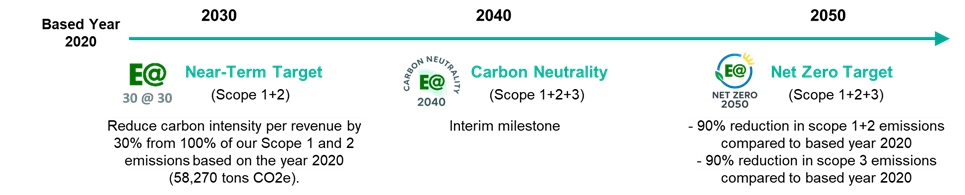
Near-Term Target : By 2030, EA Group aims to reduce the GHG emissions intensity of Scope 1 and Scope 2 by 30% (measured in tCO2e per revenue) compared with the base year 2020.
Mid-Term Target : By 2040, EA Group is committed to achieving Carbon Neutrality, covering Scope 1, Scope 2, and Scope 3 emissions.
Long-Term Target : By 2050, EA Group aims to achieve Net-Zero emission, which requires a 90% reduction in Scope 1 and Scope 2 emissions and a 90% reduction in Scope 3 emissions, compared with the base-year emissions.
Has Set GHG Targets
Yes
GHG Targets — Net Zero
Net Zero Targets
| Emission Scope | Base Year | Base Year Emissions | Near-term Target Year | Near-term Target Change (%) | Long-term Target Year | Long-term Target Change (%) | Target Year | Target Change (%) | Unit |
|---|---|---|---|---|---|---|---|---|---|
| 2716 | 2,020 | 58,338 | 2,050 | 90 | Metric tonnes of carbon dioxide equivalent | ||||
| 2715 | 2,020 | 58,270 | 2,030 | 30 | 2,030 | 30 | Metric tonnes of carbon dioxide equivalent |
GHG Targets — Carbon Neutrality
Carbon Neutrality Targets
| Emission Scope | Carbon Neutrality Certified | Base Year | Base Year Emissions | Target Year | Unit |
|---|---|---|---|---|---|
| 2716 | N | 2,020 | 58,338 | 2,040 | Metric tonnes of carbon dioxide equivalent |
GHG — Performance & Outcomes
Has Performance Results
Yes
Performance Description
EA Group promotes the transition toward a low-carbon society through the business operations, resulting in various greenhouse gas (GHG) emission reduction projects with tangible achievements at both international and national levels, as outlined below:
Global Achievement - Bangkok E-Bus Programme : This project reduces GHG emissions by replacing internal combustion engine vehicles (ICE) with electric vehicles (EV) in the public transportation system. It is a flagship project of EA Group, as it represents the world’s first international carbon credit transaction under Article 6.2 of the Paris Agreement, based on bilateral cooperation between Thailand and Switzerland, concluded on 24 June 2022. The project has been continuing and has delivered carbon credits known as International Transferred Mitigation Outcomes (ITMOs) to the Klik Foundation of Switzerland.
Thailand Voluntary Emission Reduction Program (T-VER) : EA Group has participated in the T-VER program, by Thailand Greenhouse Gas Management Organization (TGO), continuously for nine years. The GHG emission reductions achieved from EA Group’s projects have been certified as carbon credits, which can be traded in Thailand’s voluntary carbon market. In 2025, the projects certified as carbon credits include:
Carbon Credit from a Solar Energy Business : EA Group’s solar power plants located in Nakhon Sawan, Lampang, and Phitsanulok achieved annual GHG emission reductions in 2024 totaling 331,899 tCO2e
Carbon Credit from a Wind Energy Business : EA Group’s wind power plants located in Chaiyaphum and Nakhon Si Thammarat achieved annual GHG emission reductions in 2024 totaling 420,577 tCO2e
Environmental Legal Incidents
Legal Violation Incidents
| Metric | Current Year | Previous Year | Two Years Ago |
|---|---|---|---|
| Number of cases or incidents of legal violations or negative environmental impact (cases) | 0 | 0 | 0 |
Other Environmental Management
Plan Description
Air Pollution Management Plan
EA Group has implemented the Environmental Management System (EMS) in accordance with ISO 14001 across whole organization to ensure strict air pollution control, with the following measures:
1. Air Pollution Control : The Standard Operating Procedures (SOPs) have been established. Air pollution control systems have been installed at pollution sources and are regularly maintained.
2. Air Pollution Monitoring : Air quality is monitored on a regular and continuous basis, including measurements of Nitrogen Oxides (NOx), Sulfur Oxides (SOx), and Volatile Organic Compounds (VOCs). All monitoring results indicate that pollutant levels remain within safe level and are below the applicable legal standards.
Performance and Outcomes of Air Pollution
In 2025, the air pollutant emissions of EA Group were effectively controlled and continuously monitored, with no exceedance of the legally local air quality standards.
Biodiversity
EA Group recognizes biodiversity as a material issue, particularly for its solar and wind energy businesses, which have significant interactions with nature in terms of both dependency and impact. As a result, EA Group conducts biodiversity studies for each business area and performs assessments in line with international frameworks in order to mitigate operational and reputational risks.
1. Solar Energy Business : The installation of solar panels requires large land areas, which may affect habitats of certain plant and animal species. In addition, solar panels require regular cleaning during operation, which may impact local ecosystems, particularly in areas that are vulnerable to water scarcity.
2. Wind Energy Business : Electricity generation from wind power relies on wind to rotate turbine blades, which may pose risks to birds and other avian species in the surrounding areas. Therefore, studies on bird migration routes and species present in the project areas are essential in order to avoid sensitive locations and to support informed site selection decisions.
Biodiversity Management Plan
EA Group is committed to creating a Net Positive Impact (NPI) on biodiversity by applying the Mitigation Hierarchy approach to avoid, minimize, and restore impacts on ecosystems across its areas of operation and throughout the value chain. To align with international biodiversity assessment process, EA Group has adopted the LEAP framework (Locate, Evaluate, Assess, Prepare), as recommended by the Taskforce on Nature-related Financial Disclosures (TNFD), in conjunction with primary data from the WWF Biodiversity Risk Filter (WWF BRF). This approach is used to assess nature-related risks and opportunities through the following four key steps :
L - Locate: To identify the geographic interface of EA’s operations and value chain with ecosystems, particularly in areas that are sensitive or important for biodiversity.
E - Evaluate:To evaluate the company's significant dependencies on nature and the impacts of our operations on ecosystems.
A - Assess:To identify, analyze, and prioritize the company's material nature-related risks and opportunities that could significantly affect our financial position and strategy.
P - Prepare:To prepare measures to respond to the identified risks and opportunities and to prepare for disclosure to stakeholders aligned with the TNFD framework.
Performance and Outcomes of Biodiversity
According to the results of the LEAP assessment, the most significant biodiversity risk within the EA Group’s operational areas is impacts on wildlife (score: 4.00), followed by pollution-related risks (score: 3.92) and land-use change risks (score: 3.50). These findings enable EA Group to systematically analyze and prioritize biodiversity impacts by applying the Mitigation Hierarchy, which guides the sequencing of actions to avoid, minimize, restore, and offset negative impacts on nature and biodiversity.
EA Group monitors and evaluates the biodiversity management performance through the following key activities:
1. Monitoring and Evaluation Process :The results of quarterly biodiversity monitoring and evaluation across EA Group are used to continuously improve and further develop the Biodiversity Action Plan (BAP).
2. Monitoring Framework and Key Performance Indicators (KPIs) : To ensure effective implementation, EA Group has established clear KPIs for relevant business units, enabling systematic tracking of biodiversity impact mitigation measures and ensuring that actions are carried out in line with defined objectives.
Employees — Plan & Guidelines
Has an Employee Management Plan
Yes
Plan Description
Employee training and development
The Company has communicated and provided training on ethics, anti-corruption, risk management, information technology security, the Personal Data Protection Act, non-discrimination and anti-harassment policies, and policies promoting diversity and acceptance of individual differences. The Company has developed content that allows employees to learn and review the material independently, with tests to assess their knowledge on ethics, anti-corruption, risk management, information technology security, the Personal Data Protection Act, non-discrimination and anti-harassment policies, and policies promoting diversity and acceptance of individual differences. Employees at all levels, both Thai and foreign, have acquired knowledge and passed the tests, accounting for 79.1%
Promoting Employee Relations and Engagement
The Company promotes employee relations and engagement through three mechanisms: the Welfare Committee, the Employee Committee, and the Labor Union. These mechanisms help foster cooperation, promote fairness, improve welfare to meet employees' needs, enhance quality of life, and reduce labor disputes. This creates a sense of involvement among employees, ensures fairness within the organization, and reduces labor conflicts. The result is a strong, efficient organization capable of retaining talented individuals for a longer period.
Plan Document Link
https://sustainability.energyabsolute.co.th/en/social
Plan Areas
| Plan Area |
|---|
| Employee training and development |
| Promoting employee relations and participation |
Employees — Workforce
Employees with Disabilities — Introduction
The details represent consolidated information of the Company and its subsidiaries that have employees.
Workforce Data
| Metric | Current Year | Previous Year | Two Years Ago | Remark |
|---|---|---|---|---|
| Total number of employees (Persons) | 1,198 | 1,180 | 2,130 | |
| Number of male employees (Persons) | 853 | 825 | 1,588 | |
| Number of female employees (Persons) | 345 | 355 | 542 | |
| Total employment of disabled persons (people) | 18 | 20 | 19 | The Company has revised the figures for 2023 and 2024 to align with the updated information. |
| Total disabled employees (people) | 1 | 9 | 9 | |
| Total male disabled employees (people) | 1 | |||
| Total female disabled employees (people) | 0 | |||
| Total disabled workers who are non-employee (people) | 17 | 11 | 10 | |
| Contributions to the fund for promoting and improving the quality of life for disabled persons | 0 | 0 | 0 | |
| Total number of male employees in operational level (Persons) | 746 | 713 | ||
| Total number of male employees in management level (Persons) | 86 | 91 | ||
| Total number of male employees in executive level (Persons) | 21 | 21 | ||
| Total number of female employees in operational level (Persons) | 302 | 307 | ||
| Total number of female employees in management level (Persons) | 36 | 44 | ||
| Total number of female employees in executive level (Persons) | 7 | 4 |
Employees — Remuneration & Provident Fund
Remuneration & Provident Fund
| Metric | Current Year | Previous Year | Two Years Ago |
|---|---|---|---|
| Total disabled employees (people) | 688,289,612.02 | 945,936,522.67 | 177,915,022 |
| Total male employee remuneration (Baht) | 498,000,277.8 | 691,133,202.31 | 115,250,291 |
| Total female employee remuneration (Baht) | 190,289,334.22 | 254,803,320.36 | 62,664,731 |
| Number of employees eligible to participate in PVD (persons) | 934 | 1,044 | 0 |
| Total number of employees joining employee provident fund (Persons) | 563 | 635 | 866 |
| Percentage of total number of employees joining employee provident fund to total number of employees (%) | 46.45 | 53.81 | 40.66 |
| Number of PVD members / Total eligible employees (%) | 60.28 | 60.82 | 0 |
| Total amount of provident fund contributed by the Company (Baht) | 25,626,684 | 26,367,132 | 25,748,240 |
| Total amount of provident fund contributed by employee (baht) | 26,091,652 | 38,960,849.54 | 37,292,197.42 |
Employees — Training & Development
Training Data
| Metric | Current Year | Previous Year | Two Years Ago |
|---|---|---|---|
| Average employee training hours (Hours / Person / Year) | 52 | 43.67 | 33.38 |
| Employee development and training expenses (baht) | 3,788,128.43 | 3,877,284.3 | 2,673,150 |
Employees — Occupational Health & Safety
Occupational Health & Safety Data
| Metric | Current Year | Previous Year | Two Years Ago |
|---|---|---|---|
| Total number of lost time injury incidents by employees (Cases) | 2 | 6 | 14 |
Employees — Labour Relations
Labour Relations Data
| Metric | Current Year | Previous Year | Two Years Ago | Remark |
|---|---|---|---|---|
| Total voluntary resignations (Persons) | 222 | 408 | 396 | |
| Male employees who voluntary resigned (Persons) | 137 | 267 | 261 | |
| Female employees who voluntary resigned (Persons) | 85 | 141 | 135 | |
| Percentage of employee turnover leaving the Company voluntarily (%) | 18.53 | 34.58 | 18.59 | |
| Evaluation result of employee engagement | 1 | 0 | 1 | The Company conducted an employee engagement survey using assessed key dimensions, including job satisfaction, clarity of purpose, and overall workplace happiness. The most recent survey conducted in 2025 indicated an engagement level of 49%. To further strengthen employee engagement and satisfaction, the Company has set a target of 75% for 2026. This target has been cascaded across all Business Units, with clear expectations for each unit to develop actionable plans and continuously monitor progress, particularly in areas of satisfaction within their direct control. For factors related to people, workplace environment, systems, and other aspects overseen by central functions—such as Human Resources (HR), Information Technology (IT), Investor Relations and Public Relations (IRPR), and Safety, Health, and Environment (SHE)—these have been consolidated and translated into specific action plans. These initiatives are also incorporated into the KPIs of the respective central functions to ensure accountability. Through this integrated approach, the Company aims to drive collective ownership across all functions in achieving the targeted improvement in employee engagement and satisfaction. In line with the Company’s survey cycle of every 1–2 years, no engagement survey was conducted in 2024. Instead, the Company focused on implementing targeted action plans to enhance employee engagement and satisfaction. |
Employees — Employee Representation
Introduction
Welfare Committee
The Group is committed to enhancing the quality of life of all employees to promote a balance between work and personal life. The Company has established a Welfare Committee in the workplace (Freedom of Association), comprising five employee representatives elected in accordance with legal requirements.
The Committee serves as a communication channel to convey employees’ welfare needs to the Company, as well as to provide recommendations and monitor the Company’s welfare management practices. The Company provides welfare and benefits beyond those required by law to all employees on a non-discriminatory basis.
Employees are entitled to various benefits, including annual health check-ups, life insurance, accident insurance, dental care, vision care, personal protective equipment (PPE), employee loan programs with preferential interest rates through financial institutions, and a provident fund.
In addition, employees’ family members, including spouses and children/adopted children, are eligible to receive medical coverage by paying insurance premiums at the same rates and under the same benefit conditions as employees.
Employee Committee
The Company promotes equality and respects diversity among employees. The Human Resources Department supports and collaborates with the Employee Committee to ensure that it operates transparently and effectively. Information sharing and negotiations are conducted in a fair and constructive manner, contributing to a positive organizational culture and reducing the likelihood of labor disputes in the future.
The Company has undertaken the following actions:
Providing necessary information, including labor laws, corporate policies, and workforce statistics, to support informed decision-making by the Employee Committee.
Facilitating meetings, including meeting rooms, schedules, and relevant documentation, to promote transparent discussions and negotiations.
Organizing regular meetings, with clearly defined agendas, proper documentation of minutes, and transparent communication of outcomes to build trust between management and employees.
Monitoring and evaluating performance, to assess whether the Committee operates effectively, identify any challenges, and continuously improve collaboration between the Human Resources Department and the Employee Committee for mutual benefit.
Labor Union
The labor union plays a primary role in protecting employees’ rights and negotiating with the employer regarding wages, working conditions, and collective labor agreements with the company. It aims to reduce conflicts in negotiations and to use constructive dialogue. The labor union adopts an approach to develop collaborative bargaining strategies instead of confrontation, by providing both formal and informal negotiation channels for the human resources department and the labor union. It also develops conflict resolution approaches by establishing a central committee to assist in mediation, as well as organizing training on labor laws and employees’ rights for union representatives.
Employees Are Represented Collectively
Yes
Forms of Representation
| Form |
|---|
| Welfare committee |
| Employee committee |
| Labor union |
Employees — Targets
Has Set Employee Targets
No
Employees — Performance & Outcomes
Has Performance Results
Yes
Performance Description
Promoting a good quality of life for employees and their families within the group of companies
The group is committed to creating an excellent work environment by prioritizing the happiness and comfort of employees through the use of digital technology to facilitate work processes. It also provides multiple communication channels to ensure employees are promptly informed of company news and activities. As a result of this approach, there has been an improvement in the work environment, the development of skills, and quality training, as well as activities that promote employee engagement within the organization.
Additionally, the group has implemented a Hybrid Working model in almost every department at the headquarters to provide employees with flexibility in choosing their work location and schedule, supporting the creation of a work-life balance in the digital era.
The group places importance on the Diversity and Inclusion (D&I) policy, focusing on caring for employees through an inclusive approach that covers all levels, genders, and age groups. For example, the company promotes child care benefits for both mothers and fathers to allow employees the opportunity to spend important time bonding with their families. Female employees are entitled to 98 days of maternity leave as required by law. Male employees are entitled to 3 days of paternity leave. Both female and male employees are entitled to 6 days of paid leave to care for their parents, spouses, or children who need to be hospitalized. These benefits are additional to the employee rights provided by law.
Furthermore, the Company has reviewed the benefits and compensation for employees within the group, considering relevant factors and ensuring efficient resource management. Furthermore, the Company has reviewed and updated the marriage leave policy to cover employees of all genders, clarifying the criteria and procedures for requesting leave to reduce complexity and promote equal access to rights.
The approach to managing and developing human resources is an integral part of the Group’s strategy to drive sustainability and enhance long-term organizational competitiveness. The Group remains committed to continuously developing and improving its policies to align with the changing environment and the evolving needs of employees.
The Group promotes employee well-being in all dimensions. In 2025, the Group organized activities to enhance employees’ knowledge and understanding of investment through the Provident Fund. In addition, the Group focuses on providing a supportive working environment. Each business unit is able to propose and implement relevant initiatives through the Occupational Health, Safety, and Environment (OHSE) function, in collaboration with the General Administration Department.
Customers — Plan & Guidelines
Has a Customer Management Plan
Yes
Plan Description
In the production business segment, the Company manufactures products to meet quality and standard requirements, with final products randomly inspected by end customers to verify quality. Additionally, the Company aims to achieve a customer satisfaction rate of over 95% and has consistently maintained this target. Regarding the protection of customers’ personal data, the Company strictly complies with the Personal Data Protection Act (PDPA). In the power plant business segment, electricity sales are conducted under Power Purchase Agreements (PPAs) with the Electricity Generating Authority of Thailand (EGAT) and the Provincial Electricity Authority (PEA) in Lopburi Province. The department places significant emphasis on electricity customer management, focusing on contract administration, relationship building, and service enhancement to achieve maximum customer satisfaction. Key activities include contract negotiations (establishing terms from the start of electricity sales at COD and coordinating updates to keep contracts current), database management, and analyzing electricity production trends to deliver power according to the planned schedule or as close to it as possible. The department also collaborates with customers to improve electricity production systems in compliance with the Grid Code 2019, ensuring the project is fully prepared in all aspects. The main objectives are to maintain strong relationships, enhance service standards, and increase customer satisfaction. Currently, the department conducts quarterly customer satisfaction surveys using a dedicated form, with a target evaluation score of no less than 80%.
In addition, the Company focuses on building strong and sustainable relationships with customers, which benefits the business in the long term and supports sustainable growth while enhancing competitiveness in the market.
Plan Document Link
https://sustainability.energyabsolute.co.th/th/document/viewer/121/customer-service-code-of-conduct
Plan Areas
| Plan Area |
|---|
| Responsible production and services for customers |
| Development of customer satisfaction and customer relationship |
| Protection of customer personal information |
Customers — Satisfaction Results
Introduction
As a result of systematic customer relationship management, along with the continuous development and improvement of product and service quality, the Company achieved its customer satisfaction targets in 2025 and received no customer complaints.
At the Hadtkanghan project in Nakhon Si Thammarat Province, meetings were held with internal departments of the Electricity Generating Authority of Thailand (EGAT) to improve the power plant’s internal systems in compliance with grid connection requirements and power system operation regulations. Currently, the project progress exceeds 60%.
Customer Satisfaction Results
| Metric | Current Year | Previous Year | Two Years Ago |
|---|---|---|---|
| Evaluation results of customer satisfaction | 1 | 1 | 1 |
Customers — Targets
Has Set Customer Targets
Yes
Targets
| Indicator | Target Areas | Base Year | Target Year | Target Year — Description |
|---|---|---|---|---|
| Customer satisfaction | 3009 · Description: Development of customer satisfaction and customer relationship | 2,025 | The customer satisfaction score is above 97% | |
| Customer Satisfaction | 3009 · Description: Development of customer satisfaction and customer relationship | 2,024 | 2,025 | Customer satisfaction score in the power plant business segment exceeded 80%. |
Customers — Performance & Outcomes
Has Performance Results
Yes
Performance Description
In the biodiesel business segment, the Company received the 2024 Innovation Product Award in the Automotive and Renewable Energy category for EA BiO-PCM, recognizing its continuous development efforts to achieve better results and meet future customer needs.
In the power plant business segment, meetings were held to discuss improvements to the voltage control system (kV Control), cooperation was provided in electricity quality measurements, and participation was made in seminars with the Provincial Electricity Authority, Region 3.
Community & Social — Plan & Guidelines
Has a Community & Social Plan
Yes
Plan Description
Corporate Social Responsibility (CSR) project
The Group establishes its operational strategy and objectives by taking into account the interests of the Company’s stakeholders, under the principles of sustainable development (SDGs). The primary goal is to coexist sustainably with the community, based on equality and local participation, with an awareness of the importance of the community as a partner. The sustainable development framework operates under the 3S Model to reduce potential impacts and focuses on developing community capacity in three key areas: environmental, economic, and social. The Group is committed to improving the quality of life and well-being of people, communities, and society, as well as reducing poverty and income inequality—particularly in Thailand’s agricultural sector, which is relatively vulnerable, has unstable income, and may lead to poverty in the future. Therefore, the Company implements social initiatives through Creating Shared Value (CSV) in collaboration with communities surrounding the Company’s projects. In this regard, the Sustainable Development Department is responsible for planning, driving, coordinating collaboration, and systematically monitoring and evaluating operations, to ensure that various projects can create shared value between the organization and the community, and lead to truly sustainable development. The Group has established a “Corporate Social Responsibility Policy” as a guideline for implementing business process management (CSR-in-Process), consisting of the following 7 principles: Principle 1: Good Corporate Governance Principle 2: Fair Business Practices Principle 3: Human Rights and Employee Treatment Principle 4: Consumer Responsibility Principle 5: Environment and Safety Principle 6: Community and Social Development Participation Principle 7: Development and Dissemination of Innovations from Corporate Social Responsibility Operations
Sustainable Community Development Framework – 3S Model
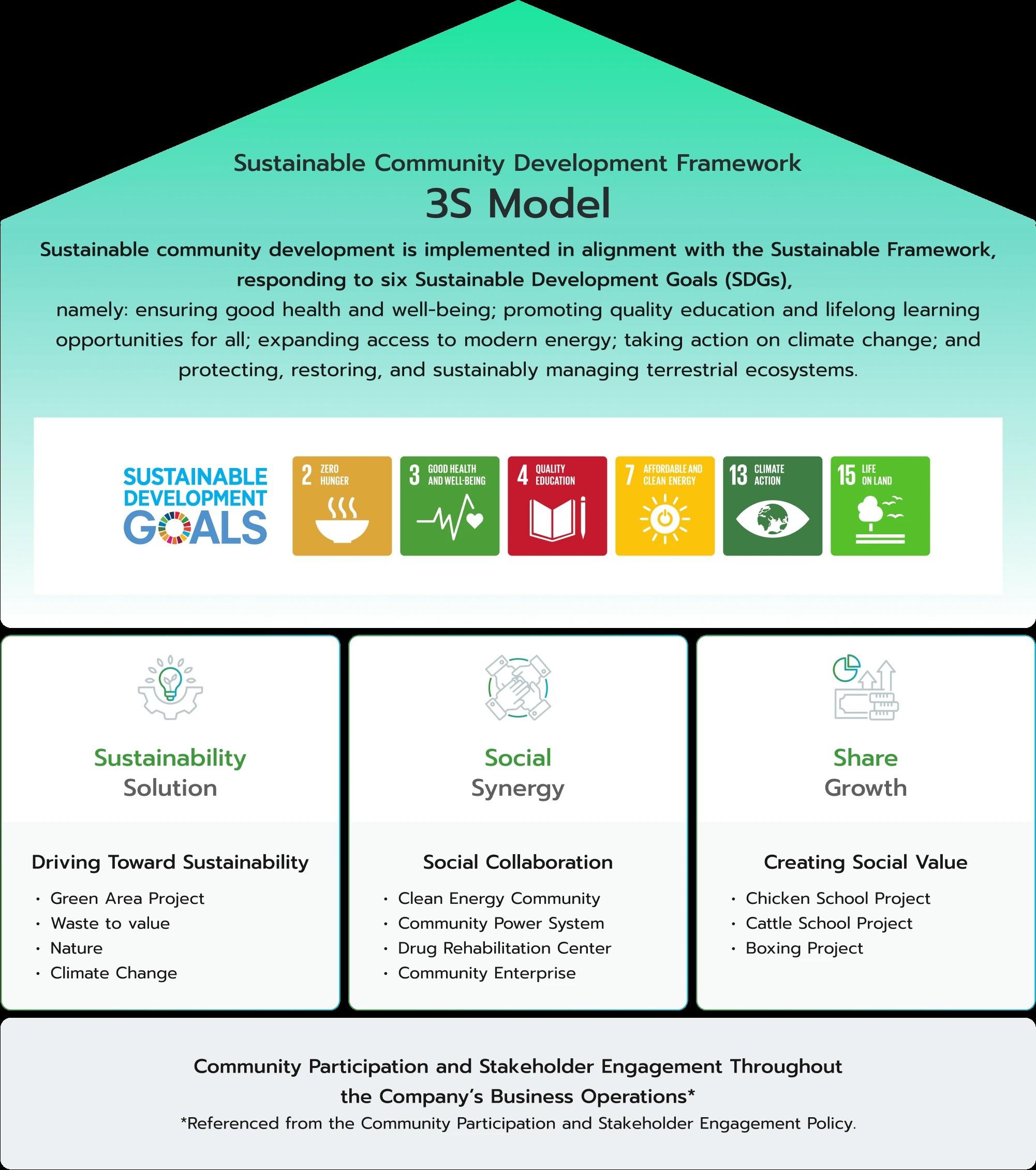
The Group has established a sustainable community development framework under the 3S Model as a strategic mechanism for implementing sustainable community development. It responds to 6 key SDGs, focusing on integrating sustainability into operations across the entire value chain. This framework is divided into 3 main pillars:
Sustainability Solution – focusing on environmental and climate management through Green Area and Waste-to-Value projects.
Social Synergy – focusing on fostering collaboration with communities and promoting well-being through support for communities surrounding the power plants.
Share Growth – focusing on developing the grassroots economy and sustainable education through Egg-Laying Chicken School and community enterprise projects. All these initiatives aim to ensure well-being, education, access to new energy, and the sustainable protection of ecosystems.
Community Development Participation Process The Group takes into account the potential impacts of its operations on communities surrounding its projects, which are key stakeholders. Therefore, the Community Relations Department implements social initiatives to build good relationships with these surrounding communities. This involves ongoing dialogues with the communities to create awareness and understanding of the Group’s operations, fostering sustainable and harmonious coexistence.
The Company’s engagement with stakeholders, with awareness of the communities located around its projects The Corporate Social Responsibility Department conducts community consultations in accordance with guidelines set by government agencies before initiating any project. In addition, it continuously monitors community opinions, suggestions, and needs. Dedicated staff and community relations teams are assigned to each project to visit the area, meet and communicate with residents, coordinate activities, and gather feedback. This feedback is used to report issues arising from the Company’s operations, the community’s needs, and proposed solutions from the community, which are then analyzed to develop plans tailored to each specific area. In addition to working directly with communities, the Corporate Social Responsibility Department manages the Group’s stakeholders in accordance with requirements and business standards, ensuring that both the Company and the communities can grow and develop together sustainably. Opportunities are also provided for the Company’s stakeholders to visit projects, helping to clarify any questions or concerns they may have regarding the Company’s operations.
Plan Document Link
https://sustainability.energyabsolute.co.th/en/social
Plan Areas
| Plan Area | Other — Please Specify |
|---|---|
| Employment and professional skill development | |
| Education | |
| Forests and natural resources | |
| Occupational health, safety, health, and quality of life | |
| Disadvantaged and vulnerable groups | |
| Others | Project for public interest |
Community & Social — Targets
Introduction
The Community Relations Department has developed work plans and success indicators for various project areas, focusing on community participation and sustainable development. The following targets have been established:
Enhance and expand Corporate Social Responsibility projects
Foster community satisfaction
Share happiness with the community
Improve the quality of life of the community
Has Set Community & Social Targets
No
Community & Social — Performance & Outcomes
Has Performance Results
Yes
Performance Description
Performance / Success Indicators
Based on the Group’s business operations, the Company adheres to a policy of acting with care and sincerity, as well as being committed to managing and looking after stakeholders affected by its operations. These stakeholders include shareholders, customers, business partners, creditors, communities surrounding the projects, employees, external organizations, and government agencies. These individuals and organizations are highly important to the Company’s business operations. The Group has applied the principles and objectives of the Sustainable Development Goals (SDGs) to align with its business operations. In 2025, the Company categorized its performance into 3 key dimensions: Economic, Social, and Environmental, to generate real benefits for the community and society.
Strengthening Grassroots Economic Security and Community Enterprises
The Group promotes grassroots economic security by developing community capacity and encouraging participatory ownership. This is implemented through the Smart Farm project, an organic farm in Phitsanulok Province, using Smart Agriculture systems to increase production efficiency, reduce costs, and provide stable income for local farmers, leading to improved quality of life and sustainable self-reliance.
Promotion of the Community Enterprise “Matong Housewives Group”: The Company supports and promotes the establishment of a community enterprise in its operational area, which began in October 2025 to create economic opportunities and increase income for the local community. The Company provides support in knowledge transfer, product development, and management to enhance operational efficiency and product diversity. As a result, group members have gained skills and capacity for long-term growth.
Workforce Skill Development: The Clean Energy Skills Development Project supports the establishment of Green Learning Centers in collaboration with the Department of Skill Development. This includes practical training on solar panel installation. The initiative strengthens the quality workforce for the clean energy sector, contributing to the country’s sustainable energy transition. A total of 217 participants attended the training in Nonthaburi, Phitsanulok, and Phichit provinces.
Promotion of a Weaving Vocational Training Center in a Community Enterprise, Rayong Province: This initiative preserves local wisdom in collaboration with WHA Eastern Industrial Estate (Map Ta Phut) and the Faculty of Arts, Burapha University.
Enhancing Quality of Life, Well-Being, and Educational Opportunities
The “Egg-Laying Chicken School” project supports raising chickens to produce fresh eggs for school lunch programs for 210 students. Any surplus eggs from meal preparation are sold to generate income for the project to cover chicken feed costs. This initiative helps reduce school lunch expenses by approximately 46,200 baht per month (calculated from the average per-student lunch cost under the Office of the Basic Education Commission). The savings can then be allocated to develop other learning activities or projects for the benefit of students. The project also serves as a hands-on agricultural learning center, teaching students principles of animal husbandry, hygiene, harvesting, and resource management. These skills can be developed into future career opportunities while fostering awareness of self-sufficiency and community reliance within the educational setting.
Agricultural Knowledge Promotion Projects, such as the “Cow School,” develop students’ vocational skills through hands-on learning in animal husbandry and systematic production management. The program also provides a foundation for students to pursue careers after graduation, whether in small-scale farming, agricultural product processing, or participation in community enterprises. The Company’s support plays a key role in enhancing the quality of education, promoting vocational skills, and strengthening the community in the long term.
Access to Healthcare Services
Maintenance of Absorbent Material in Oxygen Generators (Ongoing Project): To extend the lifespan of oxygen generators, the Company collaborates with the Mirror Foundation to research and identify efficient absorbent materials. In 2025, the Company supported the replacement of absorbent material in 100 units of 5-liter oxygen generators. This continues the work of the Pure Heart Foundation in providing oxygen generators to medical facilities lacking equipment, ensuring patients have adequate access to treatment while reducing the cost of acquiring oxygen generators for each facility.
Drug Rehabilitation Center Project (Matong Subdistrict Municipality): The Company assigns staff to serve as rehabilitation counselors and further supports participants by providing vocational training, equipping them with skills for future employment.
The Group, in collaboration with the Pure Heart Foundation, supports charitable activities and promotes access to essential medical equipment to save the lives of emergency patients. It provides support to hospitals and government agencies to enhance public health capacity and improve the quality of services for local communities.
Environmental and Biodiversity Conservation
Increasing Green Spaces: The “EA Rak Pa” project has planted a total of 10,136 trees (as of 2025), representing 31.675% progress toward the target of 32,000 trees. The selected tree species are non-invasive and non-alien plants to align with the local ecosystem, reduce environmental risks, and enhance long-term restoration of green areas. This initiative reflects the Company’s commitment to sustainable environmental management, focusing on minimizing landscape impact, conserving biodiversity, and creating a suitable environment for communities surrounding its operational areas.
Marine Conservation: The “Green Propeller” project (Wind Power Plant, Nakhon Si Thammarat Province), in collaboration with the Coastal Fisheries Association, installed “Sang” structures and released 1 million juvenile crabs into the Gulf of Thailand. This initiative provides nursery and shelter habitats for aquatic animals, supports food security, generates income, and promotes community participation in the sustainable conservation and restoration of marine and coastal resources.
Public Benefit Projects
The Company donated essential items, such as school uniforms and sportswear, to the “Mobile Public Service for Remote Communities” project in collaboration with Thai PBS. The donations were given to Ban Nabong School, Bo Kluea Tai Subdistrict, Bo Kluea District, Nan Province, to promote learning opportunities and improve the quality of life for students in remote areas.
Other Social Management
Plan & Outcomes — Description
The Group’s Corporate Social Responsibility (CSR) operations are guided by a sustainability-focused framework, considering 3 main dimensions: Economic, Social, and Environmental. Operations are conducted with equality, mutual reliance, and balanced integration, emphasizing community engagement to assess both direct and indirect impacts and collaboratively address arising issues. Communities are also given opportunities to provide feedback, which is used to develop solutions and improvements. This approach serves as a guideline for achieving sustainable community development in line with the Company’s framework and policies.
Law Violation Incidents
Law Violation Incidents
| Metric | Current Year | Previous Year | Two Years Ago | Remark |
|---|---|---|---|---|
| The total number of cases or incidents of significant violations of laws or regulations regarding social and human rights (Cases) | 0 | 0 | 0 | The Company and its subsidiaries have not had any significant incidents of violating laws or regulations related to social matters and human rights in the past 3 years. |
| The total number of cases or incidents that cause significant labor disputes (Cases) | 0 | 0 | 0 | The Company and its subsidiaries have not had any significant labor disputes in the past 3 years. |
| The total number of cases or complaints related to consumer rights violations (Cases) | ||||
| The total number of cases or complaints related to partner rights violations (Cases) | ||||
| The total number of cases or incidents that cause disputes with the community/society (Cases) | ||||
| The total number of cases or incidents related to cyber security or customer data breaches (Cases) | ||||
| The total number of cases or incidents related to safety and occupational health at work (Cases) |